Monday, August 31, 2009

The Republican party's plans revealed

No matter how many times the health care debate comes up they stop it though lies, distortions and stonewalling. How many times will we allow it? This has to stop NOW. Even Nixon understood that if it wasn't stopped it would destroy this country. Here are the latest stories to disturb your sense of right.
I also recommend you research "The Family" an ultra-right religous group looking to rule the world so they can destroy it. (NOT hype - their definition)
http://www.amazon.com/Family-Secret-Fundamentalism-Heart-American/dp/0060559799

Three Stories

What the GOP Has Planned For America.

Michael Steele, chairman of the Republican National Committee, this week revealed a secret Republican plan that would end up eliminating all federal farm subsidies; closing down Yellowstone and Yosemite national parks; selling off the interstate highway system; and canceling Head Start, subsidized school lunches and the entire college loan program.

Read the rest of the story here.

--------------

A Change of Heart On Health Care

Wendell Potter was an executive in the health insurance industry for nearly 20 years before his conscience got the better of him. He served as head of corporate communications for Humana and then for Cigna.

He flew in corporate jets to industry meetings to plan how to block health reform, he says. He rode in limousines to confabs to concoct messaging to scare the public about reform. But in his heart, he began to have doubts as the business model for insurance evolved in recent years from spreading risk to dumping the risky.

Then in 2007 Mr. Potter attended a premiere of “Sicko,” Michael Moore’s excoriating film about the American health care system. Mr. Potter was taking notes so that he could prepare a propaganda counterblast — but he found himself agreeing with a great deal of the film.

A month later, Mr. Potter was back home in Tennessee, visiting his parents, and dropped in on a three-day charity program at a county fairgrounds to provide medical care for patients who could not afford doctors. Long lines of people were waiting in the rain, and patients were being examined and treated in public in stalls intended for livestock.

“It was a life-changing event to witness that,” he remembered. Increasingly, he found himself despising himself for helping block health reforms. “It sounds hokey, but I would look in the mirror and think, how did I get into this?”

Read the rest of this story here.


-------

The Other Side of Robert McDonnell

At age 34, two years before his first election and two decades before he would run for governor of Virginia, Robert F. McDonnell submitted a master's thesis to the evangelical school he was attending in Virginia Beach in which he described working women and feminists as "detrimental" to the family. He said government policy should favor married couples over "cohabitators, homosexuals or fornicators." He described as "illogical" a 1972 Supreme Court decision legalizing the use of contraception by unmarried couples.

The 93-page document, which is publicly available at the Regent University library, culminates with a 15-point action plan that McDonnell said the Republican Party should follow to protect American families -- a vision that he started to put into action soon after he was elected to the Virginia House of Delegates.

During his 14 years in the General Assembly, McDonnell pursued at least 10 of the policy goals he laid out in that research paper, including abortion restrictions, covenant marriage, school vouchers and tax policies to favor his view of the traditional family. In 2001, he voted against a resolution in support of ending wage discrimination between men and women.

Read the rest of this story here.

Wednesday, August 26, 2009

Texas

here is a list of some of the things Texas is good at. The shame is it wasn't like this when I got here.
From http://www.tomfortexas.com/

If Governor Perry, as he told reporters yesterday, thinks we’re doing well in comparison to other states, he’s living in a parallel universe. Just take a look at his scorecard as governor.

Texas is:

51st (counting the District of Columbia) in the percentage of people older than 25 who have a high school diploma.

50th in the percentage of unemployed people receiving benefits.

49th in teacher pay.

49thin benefits paid to women, infants and children under the WIC program.

46th in SAT scores.

And look at what we’re at the top in:

The highest homeowners insurance rates in the country.

No. 1 in the percentage of uninsured children.

No. 1 in the percentage of uninsured adults.

No. 1 in toxic chemicals released into the water supply.

No. 1 in air pollution emissions.

No. 1 in cancer-causing agents released into the air.

No. 3 in teen pregnancy rate.

No. 3 in percentage of people living below the poverty line.

One of the highest high school dropout rates in the country,

Tuesday, August 18, 2009

Follow-up - Ft. Worth Raid

On The anniversary of the Stonewall Riots the Ft.Worth police and TABC raided a newly-opened gay bar in Ft. Worth. Once it all was over a patron at the bar was in the hospital in critical condition due to a skull fracture and internal bleeding while 4 others were in jail. It was one of the worst raids on a gay bar since Stonewall. Today the Police Chief apologized for the actions of the Ft. Worth police dept. - this comes 2 weeks after an apology by TABC officials.

Read the report...

8/18/09-by Paula Brooks
Fort Worth Police Chief Jeffrey Halstead told the Fort Worth City Council today, that at least some of the problems with the June 28 raid at the Rainbow Lounge LGBT nightclub arose out of “flawed policies within the police department.”

“On today’s progress report, I am apologizing for the actions and the reflection that this gave our community,” said Halstead. “This resulted from flawed policy within the police department.”

Five people were arrested and charged with public intoxication during that raid. Two others were arrested on charges of resisting arrest, but those charges were later dropped.

The Fort Worth Police Department and the Texas Alcoholic Beverage Commission were accused of targeting the gay community and using excessive force in the raid.
Chad Gibson, 26, one of people taken into custody, had said he suffered a hairline skull fracture and internal bleeding from excessive force used during his arrest at the bar. Halstead said the department is sorting through conflicting reports of what happened to Gibson, but acknowledged that one Fort Worth officer used a pressure point technique on Gibson’s face as he assisted TABC agents in the arrest.

Police had previously said Gibson was intoxicated and had fallen down on his own during the arrest, but the TABC report said two of its agents moved him to the ground as they struggled to handcuff him.

Halstead’s apology comes almost two weeks after the TABC apologized because its investigation found three agents violated numerous policies in conducting the raid.
Two TABC agents and a supervisor, who has since resigned, could face disciplinary action ranging from a verbal warning to job termination.

Halstead also said he has learned that the Fort Worth Police Department lead the bar inspection, not the TABC as first supposed. The department has temporarily suspended all operations with the TABC.

Halstead said the investigations are not yet complete, but that a new, carefully structured policy on bar inspections has been written and will go into effect on Sept. 1, along with training on how to enforce the policy.

The Texas Local Government Code requires the Fort Worth Police Department to have its investigation of the Rainbow Lounge incident completed by Dec. 28. If the excessive force allegation is sustained, officers could face disciplinary action ranging from written reprimand to termination.

Not my child!!

In a completely underhanded disgusting move by Gov. goodhair and his ignorant cronies in the Texas Board of (mis)Education here comes a doozey. As though they hadn't already made the state of Texas a laughing stock by not teaching evolution.

Texas public schools required to teach Bible.

Posted: ("Aug 14, 2009 4:36 PM EST");

Posted by Michael Hetrick

The Texas Legislature passed House Bill 1287-Section 4 in 2007, that mandates all Texas public schools offer instruction in the literature and history of the Bible. The legislation must be implimented in the 2009-2010 school year.

Many protections were put in the law to ensure that the instruction would be "objective, not from a particular point of view, and would neither promote nor disparage any religion." Other protections include mandated teacher training, state-approved training materials and standards deemed constitutional by the Texas Attorney General.

However, the Texas Education Agency has stated that it would not provide training or materials because the state did not budget the estimated $750,000 it would need to develop the materials. Also, the State Board of Education said the curriculum standards approved were "constitutional, but were vague and provided little direction for creating a course that is so touchy."

KLTV 7's Sara Story spoke to a teacher in Whitehouse that currently teaches a Bible course, and with a representative from the Texas Education Agency. We want to know what you think about this...Love It or Hate It? Please comment below and your comments may be used in our newscast.

©2009 KLTV. All rights reserved. This material may not be published, broadcast, rewritten, or redistributed.

Saturday, August 15, 2009

DOMA and DADT

After all these years and the feelings of betrayal we felt then I STILL like President Clinton. I never cared who he slept with and still don't. I don't and never have cared that he lied about who he was fucking. The question should never have been asked in the first place. That was between he and his wife. If it was any other time in history it wouldn't have been asked.

In the last few years he has proven himself to still be a good person. First with tsunami relief then with Katrina relief. More recently with rescuing the 2 journalists in North Korea (however stupid they are).

This last week he has been speaking in support of the Health Insurance Reform bill. He sees a chance now to finish what he attempted to do in '93. I applaud him for his efforts.
Here is an exerpt from his speech at "Netroots Nation" where he was interrupted by a blogger asking about DADT and DOMA.

Thursday, August 13, 2009

break it down

NO comment really needed here.

David Leonhardt has a nice article breaking down the sources of the growth in the budget deficit. Since Leonhardt works for The New York Times rather than USA Today, they didn’t see fit to illustrate his article with a pie chart, but I made one myself:

from a conservative?!?!

This amazing Op-Ed from the daily beast finally says in an authoritative way what many on the left have been trying to say for 6 months! That facts have a funny way of proving themselves out.
Remember when you read this that the Daily Beast is a GOP bastion favored by the likes of Michelle Malkin.

The GOP's Misplaced Rage

by Bruce Bartlett

Barack Obama, George Bush AP Photo; Getty Images Leading conservative economist Bruce Bartlett writes that the Obama-hating town-hall mobs have it wrong—the person they should be angry with left the White House seven months ago.

Where is the evidence that everything would be better if Republicans were in charge? Does anyone believe the economy would be growing faster or that unemployment would be lower today if John McCain had won the election? I know of no economist who holds that view. The economy is like an ocean liner that turns only very slowly. The gross domestic product and the level of employment would be pretty much the same today under any conceivable set of policies enacted since Barack Obama’s inauguration.

Until conservatives once again hold Republicans to the same standard they hold Democrats, they will have no credibility and deserve no respect.

In January, the Congressional Budget Office projected a deficit this year of $1.2 trillion before Obama took office, with no estimate for actions he might take. To a large extent, the CBO’s estimate simply represented the $482 billion deficit projected by the Bush administration in last summer’s budget review, plus the $700 billion Troubled Asset Relief Program, which George W. Bush rammed through Congress in September over strenuous conservative objections. Thus the vast bulk of this year’s currently estimated $1.8 trillion deficit was determined by Bush’s policies, not Obama’s.

I think conservative anger is misplaced. To a large extent, Obama is only cleaning up messes created by Bush. This is not to say Obama hasn’t made mistakes himself, but even they can be blamed on Bush insofar as Bush’s incompetence led to the election of a Democrat. If he had done half as good a job as most Republicans have talked themselves into believing he did, McCain would have won easily.

Conservative protesters should remember that the recession, which led to so many of the policies they oppose, is almost entirely the result of Bush’s policies. According to the National Bureau of Economic Research, the recession began in December 2007—long before Obama was even nominated. And the previous recession ended in November 2001, so the current recession cannot be blamed on cyclical forces that Bush inherited.

Indeed, Bush’s responsibility for the recession is implicit in every conservative analysis of its origins. The most thorough has been done by John Taylor, a respected economist from Stanford University who served during most of the Bush administration as the No. 3 official at the Treasury Department. In his book, Getting Off Track, he puts most of the blame on the Federal Reserve for holding interest rates down too low for too long.

While the Fed does bear much responsibility for sowing the seeds of recession, it’s commonly treated as an institution independent of politics and even the government itself. But the Federal Reserve Board consists of governors appointed by the president and confirmed by the Senate.

Because the president appoints the board, he has primary influence over its policies. This is especially the case for chairmen of the Fed appointed by Republicans because they often have ties to Republican administrations. Chairman Ben Bernanke was originally appointed as a member of the Fed in 2002, serving until 2005, when he became chairman of the Council of Economic Advisers in the White House, a position that made him Bush’s chief economic adviser.

As early as 2002, a majority of the seven-member Federal Reserve Board was Bush appointees, and by 2006 every member was a Bush appointee. While many critical decisions about monetary policy are made by the Federal Open Market Committee, the board’s position always prevails.

The Treasury secretary also has had breakfast with the Fed chairman on a weekly basis for decades. Consequently, most economists generally believe that every administration ultimately gets the Fed policy it wants. Therefore, one must conclude that if there were errors in Fed policy that caused the current downturn, it must be because the Fed was doing what the Bush administration wanted it to do.

To the extent that there were mistakes in housing policy that contributed to the recession, those were necessarily committed by Bush political appointees at the Department of Housing and Urban Development, Fannie Mae, Freddie Mac, and other agencies. To the extent that banks and other financial institutions made mistakes or engaged in fraudulent activity, it was either overlooked or sanctioned by Bush appointees at the Securities & Exchange Commission, the Comptroller of the Currency, the Commodity Futures Trading Commission, and elsewhere.

But in a larger sense, the extremely poor economic performance of the Bush years really set the stage for the current recession. This is apparent when we compare Bush’s two terms to Bill Clinton’s eight years. Since both took office close to a business cycle trough and left office close to a cyclical peak, this is a reasonable comparison.

Throughout the Bush years, many conservative economists, including CNBC’s Larry Kudlow, extravagantly extolled Bush’s economic policies. As late as December 21, 2007, after the recession already began, he wrote in National Review: “the Goldilocks economy is outperforming all expectations.” In a column on May 2, 2008, almost six months into the recession, Kudlow praised Bush for having prevented a recession.

But the truth was always that the economy performed very, very badly under Bush, and the best efforts of his cheerleaders cannot change that fact because the data don’t lie. Consider these comparisons between Bush and Clinton:

• Between the fourth quarter of 1992 and the fourth quarter of 2000, real GDP grew 34.7 percent. Between the fourth quarter of 2000 and the fourth quarter of 2008, it grew 15.9 percent, less than half as much.

• Between the fourth quarter of 1992 and the fourth quarter of 2000, real gross private domestic investment almost doubled. By the fourth quarter of 2008, real investment was 6.5 percent lower than it was when Bush was elected.

• Between December 1992 and December 2000, payroll employment increased by more than 23 million jobs, an increase of 21.1 percent. Between December 2000 and December 2008, it rose by a little more than 2.5 million, an increase of 1.9 percent. In short, about 10 percent as many jobs were created on Bush’s watch as were created on Clinton’s.

• During the Bush years, conservative economists often dismissed the dismal performance of the economy by pointing to a rising stock market. But the stock market was lackluster during the Bush years, especially compared to the previous eight. Between December 1992 and December 2000, the S&P 500 Index more than doubled. Between December 2000 and December 2008, it fell 34 percent. People would have been better off putting all their investments into cash under a mattress the day Bush took office.

• Finally, conservatives have an absurdly unjustified view that Republicans have a better record on federal finances. It is well-known that Clinton left office with a budget surplus and Bush left with the largest deficit in history. Less well-known is Clinton’s cutting of spending on his watch, reducing federal outlays from 22.1 percent of GDP to 18.4 percent of GDP. Bush, by contrast, increased spending to 20.9 percent of GDP. Clinton abolished a federal entitlement program, Welfare, for the first time in American history, while Bush established a new one for prescription drugs.

Conservatives delude themselves that the Bush tax cuts worked and that the best medicine for America’s economic woes is more tax cuts; at a minimum, any tax increase would be economic poison. They forget that Ronald Reagan worked hard to pass one of the largest tax increases in American history in September 1982, the Tax Equity and Fiscal Responsibility Act, even though the nation was still in a recession that didn’t end until November of that year. Indeed, one could easily argue that the enactment of that legislation was a critical prerequisite to recovery because it led to a decline in interest rates. The same could be said of Clinton’s 1993 tax increase, which many conservatives predicted would cause a recession but led to one of the biggest economic booms in history.

According to the CBO, federal taxes will amount to just 15.5 percent of GDP this year. That’s 2.2 percent of GDP less than last year, 3.3 percent less than in 2007, and 1.8 percent less than the lowest percentage recorded during the Reagan years. If conservatives really believe their own rhetoric, they should be congratulating Obama for being one of the greatest tax cutters in history.

Conservatives will respond that some tax cuts are good while others are not. Determining which is which is based on something called supply-side economics. Because I was among those who developed it, I think I can speak authoritatively on the subject. According to the supply-side view, temporary tax cuts and tax credits are economically valueless. Only permanent cuts in marginal tax rates will significantly raise growth.

On this basis, we see that Bush’s tax cuts were pretty much the opposite of what supply-side economics would recommend. The vast bulk of his tax cuts involved tax rebates—which failed in 2001 and again in 2008, because the vast bulk of the money was saved—or tax credits that had no incentive effects. While marginal rates were cut slightly—the top rate fell from 39.6 percent to 35 percent—it was phased in slowly and never made permanent. Neither were Bush’s cuts in capital gains and dividend taxes.

I could go on to discuss other Bush mistakes that had negative economic consequences, such as the Sarbanes-Oxley Act, which imposed a massive regulatory burden on corporations without doing anything to prevent corporate misconduct, and starting unnecessary wars in Iraq and Afghanistan, which will burden the economy for decades to come in the form of veterans’ benefits.

But there is yet another dimension to Bush’s failures—the things he didn’t do. In this category I would put a health-care overhaul. Budget experts have known for years that Medicare was on an unsustainable financial path. It is impossible to pay all the benefits that have been promised because spending has been rising faster than GDP.

In 2003, the Bush administration repeatedly lied about the cost of the drug benefit to get it passed, and Bush himself heavily pressured reluctant conservatives to vote for the program.

Because reforming Medicare is an important part of getting health costs under control generally, Bush could have used the opportunity to develop a comprehensive health-reform plan. By not doing so, he left his party with nothing to offer as an alternative to the Obama plan. Instead, Republicans have opposed Obama's initiative while proposing nothing themselves.

In my opinion, conservative activists, who seem to believe that the louder they shout the more correct their beliefs must be, are less angry about Obama’s policies than they are about having lost the White House in 2008. They are primarily Republican Party hacks trying to overturn the election results, not representatives of a true grassroots revolt against liberal policies. If that were the case they would have been out demonstrating against the Medicare drug benefit, the Sarbanes-Oxley bill, and all the pork-barrel spending that Bush refused to veto.

Until conservatives once again hold Republicans to the same standard they hold Democrats, they will have no credibility and deserve no respect. They can start building some by admitting to themselves that Bush caused many of the problems they are protesting.

Bruce Bartlett was one of the original supply-siders, helping draft the Kemp-Roth tax bill in the 1970s. In the 1980s and 1990s, he was a leading Republican economist. He now considers himself to be a political independent. He is the author of Reaganomics: Supply-Side Economics in Action and Impostor: How George W. Bush Bankrupted America and Betrayed the Reagan Legacy . His latest book, The New American Economy: The Failure of Reaganomics and a New Way Forward, will be published by Palgrave Macmillan in October.

Follow the Monay

This is a "guest" contribution from Jenny.
my notes-
Ever wonder what your health insurance premiums, bank fees and other assorted fees and charges pay for? Here's part of it. From http://www.opensecrets.org/orgs/list.php?order=A
I notice that the Democrats get the most money from Unions and other organizations while republicans get the most from corporate lobbyists (especially from big oil)


Heavy Hitters
Top All-Time Donors 1989-2008 Summary

Out of the Top 100 All-Time Donors
32 lean republican
33 contribute to each side about equally
35 lead democratic

AND

out of the top 20 All-Time Donors only 3 lean republican and 3 contribute equally-

therefore 14 out of the top 20 political contributors of all time lean democratic.

Therefore WE HAVE ALL THE MONEY??? You can't tell.

Sunday, August 9, 2009

A letter from a Congreesman

Yesterday I received a letter from Congressman McCaul promoting HR 3218 the Republican Healthcare bill
This is the most useless piece of legislation I have seen in a long time. I wrote to him and explained that this bill would be less than useless for me. I thanked him for sharing his viewpoint and begged him to please support regulation of the Heath Insurance and Pharmaceutical industries, reform of the Madicare system and a viable public ortion to private health insurance.
the follow ing is the summary of the bill and my notes.
Do your own research, call and write your representatives. Do SOMETHING to change this mess.

Under the Improving Health Care for All Americans Act:
 KEEP YOUR COVERAGE (my note: NOTHING CHANGES)
o Americans can keep employer-provided care without changes.
o Will not tax your employer-sponsored plan to pay for a government-run system.

 CHOICE IN COVERAGE
o Allows Americans who don’t have employer-sponsored care or those not
satisfied with their employer-sponsored plan to buy their own plan on the same
tax-advantaged basis their employer enjoys.
o Americans who pay income taxes get a dollar for dollar reduction in their tax bill
up to $2500 for individuals and $5000 per family. (I pay nearly $5k/year for crappy insurance [on an individual] - no help here)
o Americans who don’t pay income taxes get the same amount from the
government to buy a policy of their choice. (Paid for how??)
o Reduces the cost and improves the quality of health care while expanding access
and portability. (HOW???)
 POOLING OF BUSINESSES OR GROUPS TO LOWER COSTS
o Expands insurance pools by allowing churches, alumni associations, trade
associations and other civic groups to set up new insurance pools and offer
affordable health care packages for their members. (I am not a member of any of these - NO HELP HERE)
o Choosing from “group plans” will make health care more affordable and portable
while not locking individuals into keeping a job to keep their health coverage.

 PRE-EXISTING AND CHRONIC CONDITIONS COVERED AT AFFORDABLE
RATES
o The sick and those with chronic conditions will be able to buy coverage at
competitive rates through high-risk pools and reinsurance mechanisms. (Competitive compared to what???)

defending Health Insurance Reform

The Ten Health Care Talking Points EVERY DEM MUST REPEAT
  1. When you need life-saving care, private insurance companies only profit by denying you and letting you die. If you have paid your premiums on time all your life, you're as likely to be dropped by your private insurance company when you need life-saving care as you are to get treated. A public option gives you a lifeline.
  1. Private insurance companies are spending over a million dollars a day to kill the public option by inventing phony citizen groups, and trying to scare the elderly about euthanasia and pro-lifers with abortion; they know the only way to kill reform is to get people of good conscience fighting each other over misinformation, while they laugh all the way to the bank. They don't think very highly of our intelligence.
  1. We pay more than any other country to be 24th in life expectancy: while the average Canadian family spends less than $2000 a year on health care with no waiting periods for life-saving care, the average American family spends $16,800 a year, waiting for private insurance companies to approve life-saving treatments.
  1. Fourteen thousand Americans lose their health insurance every day; over forty-six million are currently uninsured.
  1. Eighteen thousand Americans DIE each year due to lack of health care: THAT'S 50 A DAY.
  1. Nearly two-thirds of American personal bankruptcies are related to health care costs.
  1. Businesses - particularly small businesses - cannot afford to provide health insurance for their employees under the current employer based private insurance system, and will be forced to either drop their coverage or go out of business unless a public option is passed.
  1. One-sixth of all our government spending is on health care, twice as much as any other country spends out of its budget. Our nation pays $2.5 trillion for care costing $912 billion.
  1. Every independent estimate says the public option will save us money, from saving 150 billion dollars (CBO) to saving 265 billion dollars (Commonwealth). The Congressional Budget Office estimates the current bill in the House would actually leave a 6 billion dollar surplus
So - if you'd rather spend more taxpayer money, bankrupt businesses, AND pay $16,800 a year for your family's private insurance coverage in exchange for a policy that can be dumped the second you actually need it, then the current system is great for you. If you'd rather spend less, wait less, have less of a chance of dying, and want to remove the corporate bureaucrat from between you and your doctor, then a public option is the way to go. Right now, even if you're lucky enough not to be dropped by your provider when you need urgent medical care, your private insurance company can overrule your doctor's advice for life-saving treatment and only offer to cover something cheaper; a public option would remove t

Thursday, August 6, 2009

side by side

To see a side by side comparison of the plans being discussed go to http://www.cprights.org/plans.php This site is run by Rick Scott - whom I have no use for, but the comparisons are honest as far as I can see.
I compared the House tri-committee plan and the DeMint plan... what a difference. I suggest seeing for yourself. I felt that the DeMint plan offered nothing but useless vouchers.
I have insurance via my work. It is horrible and expensive. I know that my company searches every year to try and find a better plan but each year they get WORSE. A voucher will not help that.

more

Insanity

In recent days the healthcare debate has gotten insane. Legislators are being screamed at, shouted down, threatened and in one case even assaulted. All of this by people that are uninformed and scared. Mostly. Some are being bussed and flown in from other parts of the country complements of Health care industry lobbyists and Pharma. Their stated goal is to disrupt and distract conversations.
Here is a blog from the Houston Chronicle with video showing a town hall meeting held in North Houston by Rep. Gene Green - by all accounts one of the more civilized and best handled town hall yet.

As part of its effort to keep 47,000,000 Americans without health care, the insurance industry and its wholly owned subsidiary, the Republican Party, has deployed thousands of rednecks to shout down members of Congress. The idea is to make it appear that Americans at the grassroots like the status quo, with insurance companies making profits hand over fist while denying the claims of people with serious medical conditions.

Houston's Gene Green was the victim of one such display of ignorant outrage two days ago. During a town hall meeting, Green was peppered with probing and relevant questions like "is it legal for me to record phone calls with your office?"

Another group of outraged insurance industry tools demanded to know why a doctor consultation would become mandatory under the health care reform plan. When Green held up the bill and repeated over and over that no such provision existed and asked protestors to point to that provision and they couldn't, the shouts only got louder -- because as we all know, truth can almost always be measured in decibels.

But the best part of the meeting was when one of the right-wing plants triumphantly asked everyone who opposes "socialized or government-run health care" to raise their hands. Virtually every arm was raised and there was much whooping back and forth among the yokels.

Then Congressman Green asked everyone who had Medicare to raise their hands and a large number went up.


Only Green, his staff, and a few sane voters present seemed to grasp that the right-wingers had there and then been made to look like the rank hypocrites they are. Undeterred, the right-wing zealots continued to harangue the incredibly patient Green, who answered every question.

That 47,000,000 people in this country go without health insurance of any kind and many millions more are underinsured is a disgrace. It is also a disgrace, but one they're willing to live with, that insurance companies do everything they can to avoid fulfilling their obligations under policies customers believe will be there when they need them. (Who hasn't spent hours on the phone with an insurance company desperately trying to persuade the person on the other end to do what the policy should make them do -- provide coverage for certain treatment, visit to a specialist or for needed medicine?)

Protesters have been organized by Conservatives for Patients' Rights. CPR -- which incidentally couldn't care less about patients' rights -- is run and funded by Rick Scott, former head of Columbia Healthcare. Here's who Rick is:


If Scott, the insurance industry, and the town hall screamers have their way, insurance companies will have no reason not continue hiking premiums while denying coverage. After all, they're in the business of collecting premiums, not paying claims. They have shareholders to answer to. It doesn't generate revenue to pay $250,000 so some eight year old girl can get leukemia treatment -- but it does do good things for the bottom line to deny, deny, and deny that claim until the treatment is no longer needed. That's the system these conservatives are fighting for.

Partisan Gridlock with Geoff Berg airs every Friday from 3:00 - 4:00 pm on KPFT, 90.1 FM in Houston, 89.5 FM in Galveston, and everywhere else at www.kpft.org.

Tuesday, August 4, 2009

Blue Cross denies coverage

We are being told constantly by those that oppose healthcare reform that the government will interfere between patient and doctor. I have stated that for years the Insurance companies are already doing that. Frankly at least I know the government won't do it for profit motives - unlike for-profit companies!

Blue Shield of CA refuses to treat cancer patient

Digg this! Share this on Twitter - Blue Shield of CA refuses to treat cancer patientTweet this submit to reddit Share This

Tue Aug 04, 2009 at 05:12:25 AM PDT

A woman and her doctor discuss cancer treatment options.

They decide on Treatment "A"

Then the insurance company decides to chime in

The sanctity of the doctor - patient relationship is then flushed down a Conservative-funded toilet.

This horror story involves a Chico, CA woman, Shelly Andrews Buta, whose insurance company won't pay for the cancer treatment that, at least for now, has saved her life.

Shelly is a former Girl Scout troop leader, and a single parent who's raising two high school students.

Shelly fought breast cancer and had been cancer-free nearly five years when, in April of 2009, she started feeling something like paralysis in the left side of her body. Medical tests showed the cancer had returned. It was on her back, one lung and, most alarming, in her brain.

The 14 tumors in her brain needed immediate attention. Specialists at UC San Francisco Medical Center recommended a procedure called gamma knife radiation, where the lesions are zapped with gamma rays and without knives.

Her doctors said without the surgery, she would die. But on the day of the procedure, her insurance carrier, Blue Shield, said it wouldn't pay the $60,000 tab.

Blue Shield of California decided that treating Shelly Andrews-Buta was just too expensive. So they overruled her doctor's decision, and denied treatment. They "recommended" a cheaper (and much riskier / less effective) alternative.

Blue Shield said it would pay instead for a less expensive treatment called whole-brain radiation, in which doctors try to kill tumors by exposing the entire brain to radiation. But Dr. Sneed said that wasn't the best option for Andrews-Buta.

"Gamma knife treatment works faster than whole-brain radiation in shrinking lesions," Sneed said. She believes Andrews-Buta's tumors are growing too quickly to be halted by the whole brain radiation.

Sneed is considered an expert on both procedures but said Blue Shield representatives didn't seem to want to listen to her opinion.

"There wasn't enough opportunity, I believe, to discuss it and talk about the pros and cons, and my rationale," she said.

So why did Blue Shield overrule Dr. Sneed? In emails, a company representative told CBS 5 Investigates that Blue Shield's position is that for patients with multiple tumors, gamma knife surgery 'does not improve survival' better than whole brain radiation.

At this point, if (when) this woman dies, there is no legal recourse. Private insurers cannot be held accountable for causing the death of a subscriber, even when they deliberately deny to cover physician prescribed treatment! This is the little known ERISA preemption rule, that bars patients from suing health insurers (when the benefit is provided through an employer). Of course, even if you buy your own junk policy (because that's all that's available in the "free" market), you'll be limited in your recourse with mandatory arbitration clauses and the like.

Shelly Buta, (a paying subscriber), had to take up a collection to pay for a round of chemotherapy. The cost was staggering; $30,000... she still owes on this balance but at least she received some treatment. Of course this is only one round of chemo.

And she's not the only cancer patient who will be forced to go without care, and maybe die early so another claim manager can get their annual bonus....

It would be advisable for Conservatives to read this tragic story (as well as others like Natalie Sarkisian's), and think long and hard before they disrupt another town hall meeting, or start spewing their usual venom about "government health care ... secret plans to kill seniors", etc, etc. These hateful miscreants need to be reminded that medical decisions in today's system are not made between the patient and their doctor; it's always the bean counter at the corporate office who decides who lives and who dies. Milton Friedman would be so proud.

Comic Relief: Blue Shield Boilerplate Response:

"Blue Shield makes medical necessity decisions based on what is the most appropriate safe and effective treatment. To do that, we rely on the best evidence-based medical research available and the clinical opinion of medical experts. While we approve of gamma knife surgery when appropriate, in this case, the most appropriate treatment is whole brain radiation therapy, which we would approve for medical necessity if requested."

Sunday, August 2, 2009

Canadian - style healthcare?

O the horrors! Imagine never having to worry about the insurance company tell you they won't cover that procedure they told you before hand they would cover! Imagine only waiting a month for cancer surgery! It's terrible!

A reality check on a reality check

For years, Canadians have feared the American health care system; now Americans are being told to fear ours

I'm a secret CNN fan. I just can't get enough of those talking heads with their gleaming teeth, wet-look lipstick and perfect coiffures. Even at 4 a.m., some gorgeous thing with flawless makeup (men and women) will be gushing about important affairs of state like Michael Jackson or that philandering governor from South Carolina.

Every once in a while, CNN will notice there's a country north of the 49th parallel that has some weird little customs, like parliamentary democracy or gun control. They then venture forth to do in-depth analysis of our quaint habits for the benefit of the enlightened viewers of, let's say, Kentucky.

Kentucky is to blame for the latest CNN investigation of Canada -- a "Reality Check" on Canada's health care. It seems the state -- known for fried chicken and racehorses -- is also home to Senator Mitch McConnell, a high-ranking Republican of impeccable conservative credentials. Senator McConnell does not like President Barack Obama's plan to reform health care, and he's decided to use Canada as a weapon to help him fight the battle.

As CNN reported, McConnell recently made a speech to the Senate referring to the "bureaucrats who run Canada's health care system" and using the Kingston General Hospital as an example of the horror of Canada's health care. KGH supposedly had waits of 340 days for knee replacement and 196 days for hip replacement. McConnell also fussed that Ontario's wait time for breast cancer surgery is three months. CNN did interview Dr. David Zelt, KGH's chief of staff, who pointed out the wait times are actually 91 days for hip replacement, 109 days for knees, and that these aren't the average wait times, but the time that nine out of 10 people have had the procedure. Many have them done much faster. For breast cancer surgery, the wait time at KGH is 23 days, across Ontario it's 34 days.

Both CNN and McConnell made a big deal out of Shona Holmes, an Ontario woman who claims she was forced by Ontario's health system to go to the United States for life-saving surgery for a brain tumour. She claims that in 2005 delays in access to treatment at home made it necessary to go to the Mayo Clinic in Arizona and pay $97,000 for her care.

In 2007, Holmes was part of a court case brought by the Canadian Constitution Foundation against the government of Ontario. The case challenges Ontario's "government-run monopolistic" health system that prohibits the sale of private health care and private health insurance for essential health services. It is still before the courts.

Holmes has become the darling of conservatives and the stop-public-health-care movement in the United States. She's testified before Congress, been on Fox TV as well as CNN, and her story is retold on hundreds of right wing blogs. She's now doing a nasty TV ad for Patients United Now, a Republican-led group opposed to Obama's reforms. You can see the ad at www.patientsunitednow.com. The group is spending almost $2 million on it to target politicians in Washington.

For a person living with cancer, the idea that someone's care could be unreasonably delayed is truly scary. It also doesn't reflect the experience I've had or the experiences that have been shared with me by so many other patients. Even CNN interviewed Doug Wright, a more typical patient in Toronto who is receiving very speedy treatment for his cancer.

Still, I found Holmes tale both compelling and troubling. So I decided to check a little further. On the Mayo Clinic's website, Shona Holmes is a success story. But it's somewhat different story than all the headlines might have implied. Holmes' "brain tumour" was actually a Rathke's Cleft Cyst on her pituitary gland. To quote an American source, the John Wayne Cancer Center, "Rathke's Cleft Cysts are not true tumors or neoplasms; instead they are benign cysts."

There's no doubt Holmes had a problem that needed treatment, and she was given appointments with the appropriate specialists in Ontario. She chose not to wait the few months to see them. But it's a far cry from the life-or-death picture portrayed by Holmes on the TV ads or by McConnell in his attacks.

In Senator McConnell's home state of Kentucky, one out of three people under age 65 do not have any health insurance. They don't have to worry about wait times for hip or knee replacement or cancer surgery -- they can't get care. The median household income in Kentucky is $37,186 -- not quite enough for the $97,000 bill at the Mayo Clinic. CNN didn't mention that in its "Reality Check."

As the debate on health care reform heats up the United States, it seems certain that Canada's public health care system will be used, or more accurately misused, in the battle for hearts and minds. For years, Canadians have feared the American health care system; now Americans are being told to fear ours.

fact checking

There are lots of claims going on about the healthcare bill. Some true some not. The Associated Press did a little research and came up with the following.

FACT CHECK: Distortions rife in health care debate
By CHARLES BABINGTON, Associated Press Writer Charles Babington, Associated Press Writer – 22 mins ago

WASHINGTON – Confusing claims and outright distortions have animated the national debate over changes in the in the health care system. Opponents of proposals by President Barack Obama and congressional Democrats falsely claim that government agents will force elderly people to discuss end-of-life wishes. Obama has played down the possibility that a health care overhaul would cause large numbers of people to change doctors and insurers.

To complicate matters, there is no clear-cut "Obama plan" or "Democratic plan." Obama has listed several goals, but he has drawn few lines in the sand.

The Senate is considering two bills that differ significantly. The House is waiting for yet another bill approved in committee.

A look at some claims being made about health care proposals:

CLAIM: The House bill "may start us down a treacherous path toward government-encouraged euthanasia," House Republican Leader John Boehner of Ohio said July 23.

Former New York Lt. Gov. Betsy McCaughey said in a July 17 article: "One troubling provision of the House bill compels seniors to submit to a counseling session every five years ... about alternatives for end-of-life care."

THE FACTS: The bill would require Medicare to pay for advance directive consultations with health care professionals. But it would not require anyone to use the benefit.

Advance directives lay out a patient's wishes for life-extending measures under various scenarios involving terminal illness, severe brain damage and situations. Patients and their families would consult with health professionals, not government agents, if they used the proposed benefit.

CLAIM: Health care revisions would lead to government-funded abortions.

Tony Perkins of the Family Research Council says in a video, "Unless Congress states otherwise, under a government takeover of health care, taxpayers will be forced to fund abortions for the first time in over three decades."

THE FACTS: The proposed bills would not undo the Hyde Amendment, which bars paying for abortions through Medicaid, the government insurance program for the poor. But a health care overhaul could create a government-run insurance program, or insurance "exchanges," that would not involve Medicaid and whose abortion guidelines are not yet clear.

Obama recently told CBS that the nation should continue a tradition of "not financing abortions as part of government-funded health care."

The House Energy and Commerce Committee amended the House bill Thursday to state that health insurance plans have the option of covering abortion, but no public money can be used to fund abortions. The bill says health plans in a new purchasing exchange would not be required to cover abortion but that each region of the country should have at least one plan that does.

Congressional action this fall will determine whether such language is in the final bill.

CLAIM: Americans won't have to change doctors or insurance companies.

"If you like your plan and you like your doctor, you won't have to do a thing," Obama said on June 23. "You keep your plan; you keep your doctor."

THE FACTS: The proposed legislation would not require people to drop their doctor or insurer. But some tax provisions, depending on how they are written, might make it cheaper for some employers to pay a fee to end their health coverage. Their workers presumably would move to a public insurance plan that might not include their current doctors.

CLAIM: The Democrats' plans will lead to rationing, or the government determining which medical procedures a patient can have.

"Expanding government health programs will hasten the day that government rations medical care to seniors," conservative writer Michael Cannon said in the Washington Times.

THE FACTS: Millions of Americans already face rationing, as insurance companies rule on procedures they will cover.

Denying coverage for certain procedures might increase under proposals to have a government-appointed agency identify medicines and procedures best suited for various conditions.

Obama says the goal is to identify the most effective and efficient medical practices, and to steer patients and providers to them. He recently told a forum: "We don't want to ration by dictating to somebody, 'OK, you know what? We don't think that this senior should get a hip replacement.' What we do want to be able to do is to provide information to that senior and to her doctor about, you know, this is the thing that is going to be most helpful to you in dealing with your condition."

CLAIM: Overhauling health care will not expand the federal deficit over the long term.

Obama has pledged that "health insurance reform will not add to our deficit over the next decade, and I mean it."

THE FACTS: Obama's pledge does not apply to proposed spending of about $245 billion over the next decade to increase Medicare fees for doctors. The White House says the extra payment, designed to prevent a scheduled cut of about 21 percent in doctor fees, already was part of the administration's policy.

Beyond that, the nonpartisan Congressional Budget Office said the House bill lacks mechanisms to bring health care costs under control. In response, the White House and Democratic lawmakers are talking about creating a powerful new board to root out waste in government health programs. But it's unclear how that would work.

Budget experts also warn of accounting gimmicks that can mask true burdens on the deficit. The bipartisan Committee for a Responsible Federal Budget says they include back-loading the heaviest costs at the end of the 10-year period and beyond.

Saturday, August 1, 2009

interesting experiment

Apparently someone decided to show how we feel... it is worth the 10 min listen.

Friday, July 31, 2009

Owning Heterosexual Privilege: What If Gay Were Considered The Norm?

No matter how empathetic a heterosexual person is, they can never truly understand the persecution that gays and lesbians go through. The following video asks us to image a different world – a world where gay is the norm and heterosexual is considered “other”.

I cannot imagine a society in which I would have to hide my love for fear of rejection, or in some cases violence because this has never been a part of my life. I have always known that my relationship would be validated because we privilege heterosexuality. I have never feared owning my relationship publicly.

No one deserves to be “othered,” because of their sexual orientation and I do believe this video gives heterosexual people a small taste of what life would be like if suddenly their/our love was considered unnatural, or unworthy. It is privilege that normally causes us to avoid placing ourselves in untenable positions that we are often all ready to create for those that we consider to be other.

Bank Failures

One aspect of this crisis that is not being discussed much especially in MSM are the bank failures. As of friday night the latest count is 69 for the year(vs 29 for all of last year). http://www.fdic.gov/BANK/HISTORICAL/BANK/index.html Most in the hardest hit areas of the country like Ohio and Calif. Friday saw a pretty good sized one in OK get seized by the FDIC and here is a story I thought you all should be aware of.. a pretty big bank here is Texas.
http://money.cnn.com/2009/07/31/news/companies/guaranty.headache.fortune/index.htm?cnn=yes

Big Texas bank on verge of failure

Guaranty Bank, which counts Carl Icahn as one if its backers, is teetering on the edge of insolvency. But it may not be easy for regulators to find a buyer.

By Colin Barr, senior writer

sheila_bair_3.03.jpg
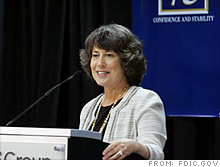
FDIC chief Sheila Bair is dealing with a surge of costly bank failures.
chart_ins_fund_balance_03.gif


NEW YORK (Fortune) -- Guaranty Bank is hardly a household name. But the Austin, Texas-based thrift's looming failure is shaping up as a big headache for bank supervisors -- not to mention a black eye for Carl Icahn and others in the smart money set.

Guaranty (GFG) could be soon seized by the government in what would be the biggest bank failure in a year that has already had 64 of them. Last week, the bank warned investors to expect a federal takeover after regulators forced a writedown of its risky mortgage investments and a bid to raise new capital failed.

Guaranty has $13.4 billion in assets and operates 160 branches in Texas and California -- two of the three best banking markets in the nation, thanks to their size and population growth.

But the bank's capital problems and its smallish, scattered network of branches could detract from Guaranty's appeal, making it tough for regulators to find a buyer quickly -- or without substantial federal subsidies.

"This may not be closed as quickly as you think, since it will require bids and rebids," said Miami banking consultant Ken Thomas.

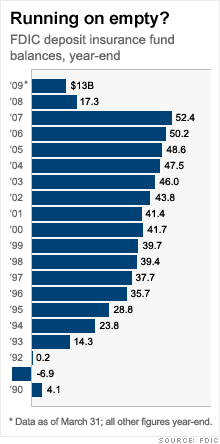
That means resolving Guaranty's failure is likely to be costly to the FDIC's deposit insurance fund, whose balance is at its lowest point in almost two decades.

The Federal Deposit Insurance Corp. isn't the only one taking its lumps. So have some big investors.

Shares of the bank's parent, Guaranty Financial, have dropped 97% since a group led by billionaire Texas hotel mogul Robert Rowling and Icahn, the renowned New York corporate raider, poured $600 million into the company in June 2008.

Other big Guaranty holders whose stakes stand to be wiped out include hedge fund managers David Einhorn, who was among the most persistent skeptics of Lehman Brothers before its collapse, and Dan Loeb.

"Relatively low franchise value and the fact that two big money investors already got burned on this bank may suggest less interest than with BankUnited," said Thomas, referring to the Florida thrift that failed in May and was bought by a group of private equity investors.

BankUnited had half as many branches and operated in only one state, but had a strong competitive position in the most lucrative counties -- something Guaranty lacks.

Despite BankUnited's relative attractiveness, its sale to investors led by vulture investor Wilbur Ross was hardly a walkover for the FDIC. The deal cost the FDIC insurance fund $4.9 billion.

A big tab on Guaranty would be costly to the deposit fund, whose balance was $13 billion at the end of the first quarter. The FDIC has estimated failure costs on cases since then at $11.2 billion.

A spokesman for the FDIC stresses that it has already set aside an additional $22 billion for failure-related costs in 2009, and adds that congressional action this spring gave the agency access to $500 billion in Treasury credit.

Though Guaranty has been around since 1988, it came public less than two years ago. Guaranty was part of the Temple-Inland (TIN) cardboard-box conglomerate until Icahn pressured the company to split up at the end of 2007. Guaranty shares were then distributed to Temple-Inland holders.

Guaranty's chief executive at the time, Ken Dubuque, assured investors that despite the gale force winds sweeping the financial world, the bank would be safe.

"We're keenly aware of the importance of good credit, disciplines and effective risk management, in good times and in difficult times," he said on the bank's first earnings conference call in February 2008.

But Guaranty's risk management soon was found wanting. The bank aimed to expand beyond lending to the builders of office buildings, shopping centers and houses to new areas such as small business and corporate energy lending.

Because its thrift charter obliges Guaranty to keep 70% of its assets in housing-related investments, the bank matched growth in other areas with expanded investments in housing. That, Dubuque said, is how the bank ended up taking on a giant portfolio of mortgage-backed securities, backed largely by option adjustable-rate mortgages in California and Texas.

"We needed to increase the size of the balance sheet, so that was a relatively risk-free way of doing it," Dubuque told investors in 2008. "We also have liked the returns in that business as well."

But securities backed by option ARMs are anything but risk-free, as investors have learned. Among institutions that dealt most heavily in those were Washington Mutual, the Seattle thrift that collapsed in September with $307 billion in assets, and Wachovia, which was sold to Wells Fargo (WFC, Fortune 500) later in 2008. Other big option ARM users included failed California savings banks Downey Financial and PFF.

Losses built at Guaranty over the past year, and Dubuque quit without explanation in November. In April regulators told Guaranty to raise more capital. When that effort failed, they told Guaranty to write down the value of the mortgage-backed securities by more than $1 billion. That move, announced this month, left the bank with negative capital of $748 million, according to filings.

Despite its many problems, Guaranty is -- for now -- operating as usual.

"We are open for business. We continue to work with our regulators," Guaranty said Friday in an emailed statement. "We are focused on providing the best customer service possible and believe we can avoid any disruptions to our customers."